Looking back on this blog I can see that I have not kept to my attempt to write at least once a week.
Let’s hope I can do better over the coming weeks!
I left off with a post about changing over from BT’s FTTC to Vodafone’s FFTP broadband. After nearly eight months, how is that going?
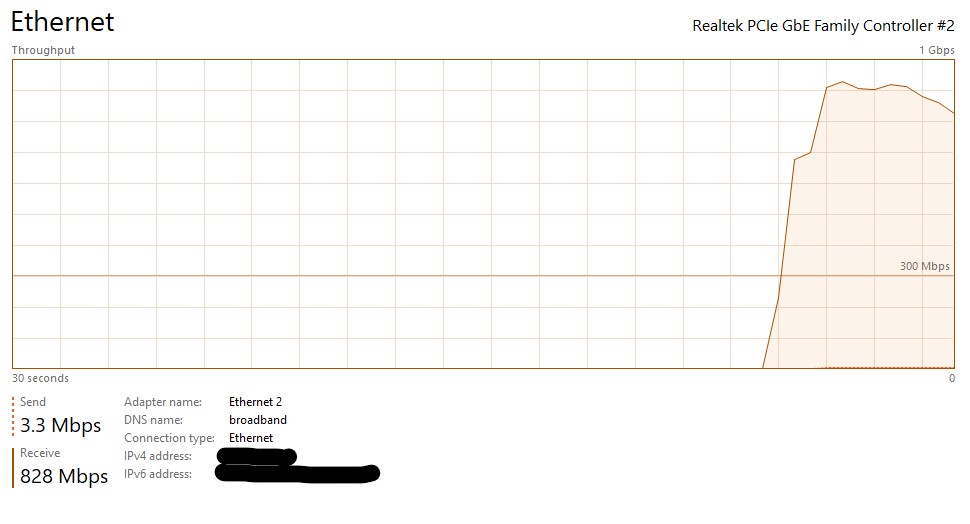
Pretty good I have to report, if you’re connected directly to the Fibre Hub/Router by cable from my desktop PC, averaging over 900mb download speed with very good upload speeds. (See image below)
However, the download speeds via Wi-Fi have not lived up to expectations. Yes, if you’re close to the Vodafone Wi-Fi router, then you can get nearly 300/350 Mb download speeds. But if you start to move away from the there is quite a quick drop-off in attainable speeds. This for me points to a very low power Wi-Fi transmitter in the Vodafone Wi-Fi Hub.
I have seen this mentioned in a few online chats as well. Have also mentioned this to Vodafone, but so far no feedback from them.
Now investigating an alternate Wi-Fi router to use in conjunction with the Vodafone Hub.
A few weeks ago City Fibre finally finished digging up our road and moved on to other places, a short while later we received an email list available Full Fibre providers and out of the list we went for Vodafone.
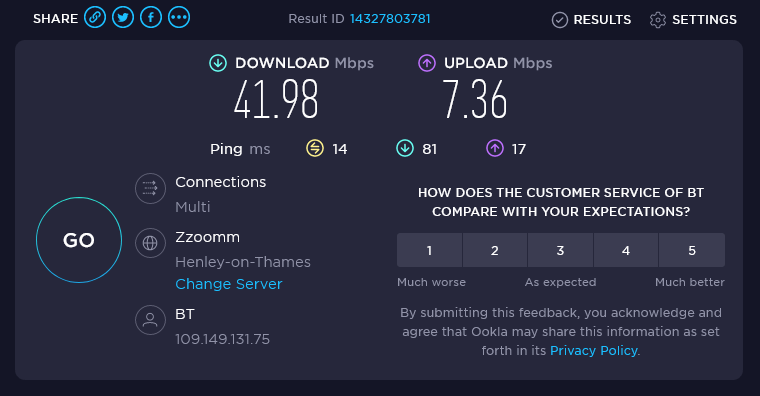
We had been a BT user for phone and broadband for many many years, from the early dial-up days right up to the latest speed that they could provide. Which only became available with their upgrade to their ‘Fibre To The Cabinet’ (FTTC) mechanism two years ago, which then delivered an average of 40Mb downloads.
Last Speed Test on BT Broadband
Although the FFTC did give a medium increase in downloading speed (doubling the previous speed) the last 50 meters from the cabinet to the house was still using copper wires. Despite a number of calls to BT over the last year, we were unable to get any kind of commitment that they were likely to replace that with ‘Fibre To The Premisses’ (FTTP). Hence, the move to another supplier for FTTP.
So how did the upgrade go? The actual physical connection work took around three hours to complete to a) run a sheathed fibre cable from the City Fibre connection port in the pavement next to the house, b) bury the cable under the front garden c) drill an access hole in the house wall to get the connection inside and finally d) to commission the connection via the new router which had been delivered a few days before.
No real issue with any of this except to say that Vodafone have been pretty cheap with the length of the cable on the mains adapter used to power the Broadband Router, it is only one meter long!! The mains adapter for the BT router is just over two meters long; so if you have positioned your previous router in a particular place for convenience/Wi-Fi reasons and you want to keep it there, then an extension lead will be required.
You will also need an extra power socket near to where the internal Optical Network Connector (ONC) box (a nice long cable for this) is located next to the access hole that has been drilled through the house wall. In the end, as we have a number of items running from original sockets, invested in a six-way surge protected extension lead which has covered everything.
The other thing that we are beginning to understand is that the Wi-Fi signal of the Vodafone router does not appear to be a strong as the previous BT router. Still testing using a number of tools and will give it a few more days to see if it improves before a calling in a report to Vodafone. We do have some Wi-Fi repeaters located around the house, but may have to look at some others if this is the standard strength.
All in all though, we do have some great download speeds, depending of course on where you are downloading from.
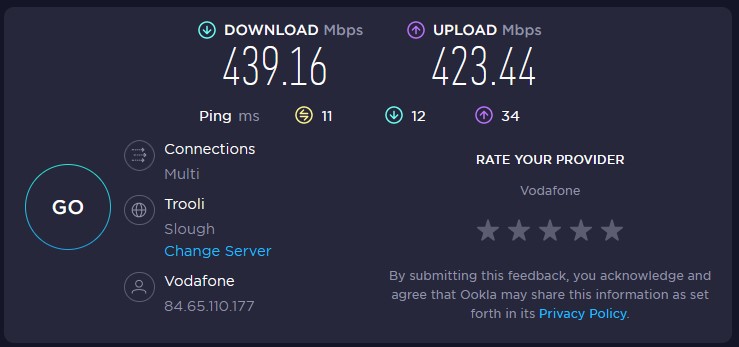
But after a week of settling in, today’s figures are…
The above speediest results are interesting, in that they show different speeds depending on whose test ‘app’ you are using.
So here is another test. Using a fixed sized (one GB) file located at Thinkbroadband.com and using the Windows 10 Task Manager Ethernet window, you can see that the download speed is nearly at the top speed of the promised spec.
Downloading to various devices
What speed should we expect on your devices from a Full Fibre connection? – This is a good question. The package we went for was the Full Fibre Vodafone 900 (900 MB) at a very good price of £30.00/month for 24 Months with a guaranteed service level minimum of 450 MB.
So many factors can determine the speed of download and of course uploading (but who cares about that!!) some of which include the age of the device such as smartphone, tablet, laptop, desktop to name a few. The connection you have to the router, fixed or Wi-Fi. The distance you are from the router. The site from where you’re downloading and the number of people downloading the same item, such as a film for example and the number of people in your household using the connection. All in all, it can get quite frustrating if you’re not aware of the various pieces of the jigsaw.
For example, after the completion of installation, we could not get any faster than 95 MB download speed via a wired connection on an HP desktop that we have. It’s around five years old and we found that the on-board network connection on the motherboard itself was only rated for transfers of up to 100 MB. To overcome that restriction, we purchased a Gigabit PCI Express Network Adapter and as soon as that was installed, speeds then reach up towards the 700/850 MB.
In regard to Smartphones, Tablets and Laptops where you can’t physically change any hardware, you’re basically stuck with whatever hardware level it is at.
Here are some devices we have checked using Wi-Fi…
Device
Download Speed (MB)
Up Load Speed(MB)
Acer
90.5
80
Motorola G9
252
301
Galaxy Tab S5e
257
296
Galaxy Tab 10
51
39
HP Desktop (Wired)
680
550
HP Desktop (Wi-Fi)
420
380
Included the HP Desktop Wired Connection for comparison.
So that’s about it for now, but I think there is more testing and evaluation to be done, but with =out a doubt it is a very different world with FTTP.
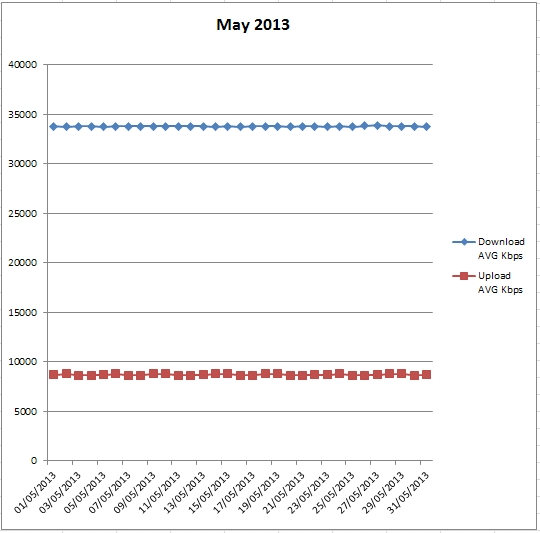
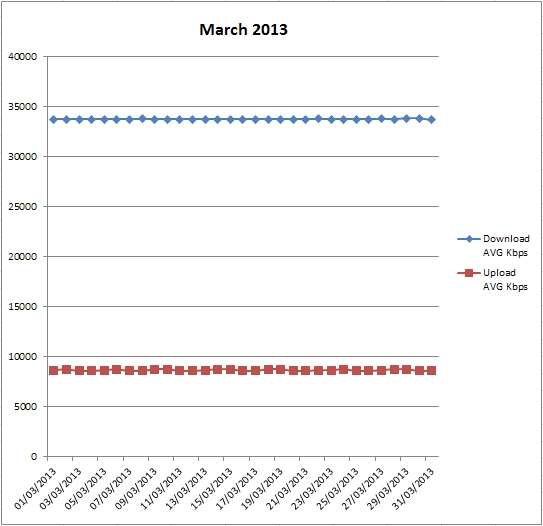
This will be the last time that I will be posting these figures in this format. Up until now I have been collecting the data manually, using a spreadsheet for collation and screen snapping an image to post into this blog. As you will see from the posted May 2013 figures below, much remains the same in that I am still maintaining a steady 32Mb (average) download speed.
Is there anything else that I can check that might be helpful?
I have used part of the Sam Knows website for many years as they have always seemed to be the one with the most up to date information about exchange configuration changes and service availability. In early May they emailed me and asked if I would like to participate in their Broadband Performance Monitoring Survey which allows them to build a UK wide picture of the sorts of broadband performance that we are getting from our Internet Service Providers.
To participate in the survey, you will need to install a ‘white-box’ in between your broadband socket and your router, the ‘white-box’ (mine is actually black) monitors the technical side of your connections performance – not what you are looking at or what files you are sending (we can leave that to GCHQ & the NSA!! Just kidding) and keeps track of a set of figures which can be reviewed via a dashboard or via monthly reports that are sent to you. Does this interfere with your connection performance? No, look at my figures.
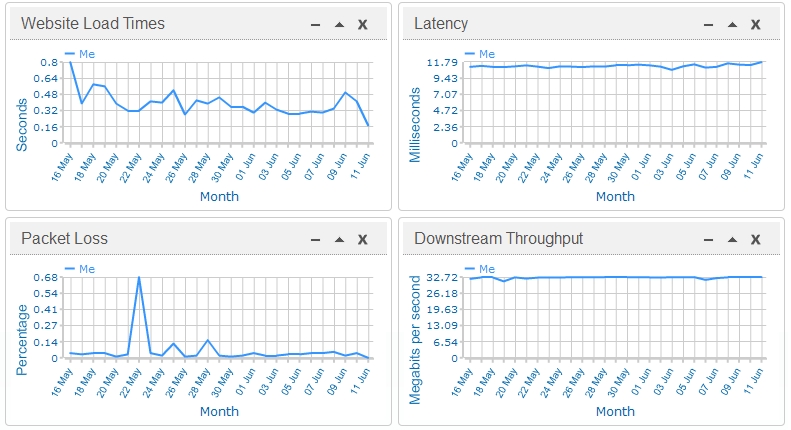
The screen snap below shows the main dashboard display, which as you can see shows that the average download speed is much the same as I have been gathering via my ‘handraulic’ method, these figures are from first use in May till today.
What is also included in this dashboard view are figures that show Website Load Times, Latency & Packet Loss all of which will affect your on-line browsing experience.
A word about each of these…
Website Load Times – This test emulates that process and shows the average time in seconds of how long a selection of popular web sites took to load. Note that results may vary according to changes in the websites being visited. The lower the figure is a better loading speed. For example, you may have a download speed of 32MB, but if the ‘distant’ website can’t serve out the pages very fast, no amount of download speed will help the page load faster.
Latency – This can effectively be thought of as the responsiveness of the connection between your home and servers out on the Internet. Times are recorded in milliseconds. The lower the figure is better.
Packet Loss – Some broadband providers have been known to suffer high packet loss at peak times. If this is the case for your ISP, then you may find that time sensitive applications such as Voice over IP (VoIP) and on-line gaming will suffer. Packet loss is recorded here as a percentage, The lower the figure is better.
There are other performance figures that can be obtained simply by altering the dashboard look.
Sam Knows will also send along a monthly report showing the main points of performance and if there are any issues, which can then be forwarded to your ISP if required. I would encourage everyone to sign up and participate in this survey.
I’ll be posting future reports here as I get the monthly reminder report cards and hopefully will continue to have an error free connection to the Internet.
Not a great deal to report on this front from February except for the uninterrupted service. However, I did find out that BT are upgrading my local fibre box which I am told will give even higher download speeds once all updates are complete.
On one of the monitoring days I did see some periods where the meter was reading around 52MB! But it only lasted for a few minutes so it’s not really worth logging that. Of course the next questions is to see what tools can accurately measure these higher speed. Most of the Broadband speed checkers are nothing more than marketing tools, however there are a few that do seem to be able to give constant feedback such as ttbmeter from ThinkBroadband and the BBC iPlayer speed connection checker. However as I have mentioned in a number of previous posts, the test results you get with these tools does vary according to the age of PC that you use to check it and the quality of the network socket software on your PC.
On a more general front, I see that according to research from regulator Ofcom, the average speed of home broadband is now 12Mbps, the BBC article covering the background can be found here.
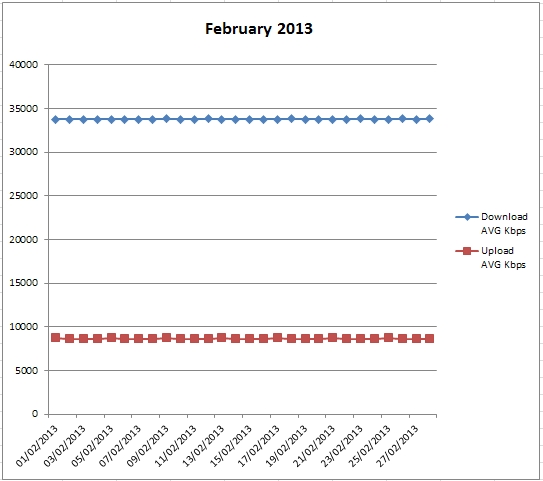
My BT Infinity broadband figures for February delivered another good month of performance.
BT replaced the Infinity modem as part of their swap out plans, although I had not seen any problems with my original modem – manufacturing fault as far as I could see. Lets hope it continues.
OFCOM have just published their latest report about the state of the UK Broadband Speed. Makes for interesting reading. Still seems that there areas for improvement in delivery and the overall speed achievable in the UK. Full report can be found here.





 Beasley's Place